Showing posts with label paring knife. Show all posts

Wednesday, February 21, 2018

A Budget Starter Set of Kitchen Knives

You don't need any special equipment for your plant-based kitchen, but there are definitely things that will make life worth living...

  • One of my favorites is a high-end rice cooker. That will forever be my first recommendation. In my book, a top-notch rice cooker will save you more time than anything else, and possibly it is the difference between success or failure, for cooking whole grains definitely takes time. I use mine every day.
  • My next favorite implement is a Börner V-Slicer, which is a mandolin. I wrote about it some time ago, and it is my next time saver.
  • There are the Nutribullet and the MagicBullet, which I consider also to be major time savers.
  • Then there is the immersion blender, which I have referred to, but I have not devoted a full blog post to it.
All of the above is good advice that will stand the test of time. However, before and after everything there are your kitchen knives, and there most people fall down, because they are the most neglected kitchen equipment in most kitchens, and we pay the price, for without good knives, cooking is no fun.

The difference can be summed up as follows: if your knife is sharp, cutting up an onion won't make you cry. If your knife is sharp, you will easily slice a ripe tomato - ripe, but firm, but not overripe and soupy. Those are the simple, unavoidable daily tests. Here is an excellent source for some serious advice for vegetable carving.

Your basic needs are really just a few things (two really, the rest is luxury):
  • a paring knife, though I'd prefer a set of paring knives and 
  • an 8" chef knife. In my experience the 10" chef knife is not much use, for us vegans don't carve a lot of turkeys. 
  • A bread knife is a basic need in some people's eyes, but I find I hardly ever use mine. 
  • After the basics, I would personally best like a Japanese nakiri knife for vegetable cutting, the more I use it, the better I like it. I'll write about nakiri knives and other vegetable knives some other time. 
  • A santoku is nice to have, but I would not miss it if I did not have it.
  • a slicer, such as a yanagiba, has not much use in the plant-based kitchen.
The upshot is, knife blocks are a waste of money. I prefer a magnetic strip on the wall, so that my knives stay sharp and are always at my finger tips. By the way, one of the side benefits of running a #WFPB kitchen is it stays much cleaner if you're not cooking with oil! Plus, I am sure that the Dept. of environmental protection will appreciate it as cooking oil in the sewers is one of their biggest headaches.

The Paring Knife

The paring knife is for everything off the board, i.e. in your hand. The site I cited above, www.knifeplanet.com, has some great advice. I would agree with their choice of paring knives, as at least reasonable, though my personal favorite is probably the MAC knife Professional paring knife at the high end, and the Rada Cutlery paring knives at the low end. Take your pick, but for a budget choice Rada Cutlery is superb. And, while you are at it, get their sharpener too. The knives will set you back about $15-$20 and the sharpener about $7.50. So assume you spend $25 on the paring knives.
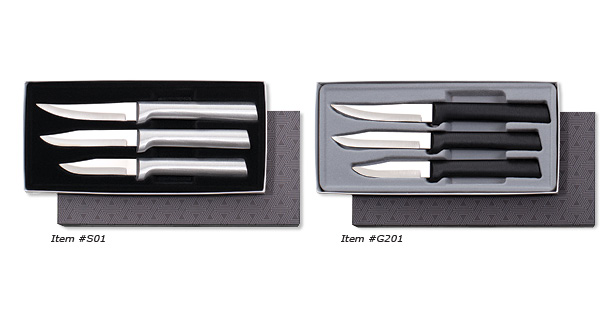
Rada Cutlery Set of Paring Knives

The Chef Knife

The Chef Knife is for is for everything on the board. It's the only other knife you REALLY need and for all practical purposes, you really only need an 8" chef knife. With a little bit of looking around you will find plenty of choices even in the budget category of $20-$40. Ryky Tran (Burrfection on YouTube), considers the Mercer Culinary Renaissance ($40) the winner in this category for 2017 and he also likes the Mercer Millennia 8" (x30cr13 steel, HRC 56, at $30). Others say the Victorinox Fibrox ($40) HRC 55-56.

Meanwhile, I have found some other interesting entries in the budget category.

  • Culinary Obsession offers a nice knife that is made of German 4116 Stainless Steel, for about $30. Notice it has a half bolster, which makes sharpening easier.
  • Imarku offers a very nice 8" Chef Knife made of high carbon stainless steel, 7CR17MOV stainless steel contains 0.7% carbon, at $29.99 with a hardness of 58-60 on HRC (Rockwell Hardness Scale), let's call it 59. This is another knife with a half-bolster.
  • Imarku offers an interesting single bevel chef knife made of German 4116 Steel, and because it is single bevel, it is extremely sharp. About 57 HRC, listed as 56-58. This is another knife with a half-bolster.
  • Lastly, there is the Kuma knife, which is quite solid, at about $25, it is made of 3Cr13 Steel. The same company also offers a decent honing rod for about $15. Don't get too course of a honing rod, you want a medium to fine. The Kuma knife showed surprising edge retention in a video by Burrfection. However, this is a full-bolster knife, and you'll have to file down the bolster over time.

Knife Sharpening

Culinary Obsession offers a pretty decent 1000/6000 grit whetstone for about $33 or so. That grit level is about all you need for regular sharpening. Only if your knife is damaged will you need to start below 1000 grit. I have just started using it, so I don't have long experience, but this stone works very well. You might want to add a nagura stone for less than $10, to get your stone started up and clean during sharpening.

Here is a fun video by Ryky Tran on the trade off decisions between a budget knife (Kuma) with some high end whetstones (Chosera 800/3000) versus a high end knife (Wusthof) with a budget combo whetstone (800/3000). It's just fun to watch. Meanwhile, if you can afford one stone, I think the 1000/6000 is a better choice. Then, if you ever need to restore damaged knives, you can get a lower grit stone. Meanwhile, the overall conclusion from the video is obviously that if you can afford it, better quality stones are worth it.

One of the best tutorials on sharpening is by Korin, the premier Japanese knife shop in NY. Here is the complete Korin Learn How to Sharpen tutorial, it is a very systematic approach.

Beyond the Basics

With the small collection that is suggested here, 3 paring knives, 2 8" chef knives, and some basic sharpening gear, you have a better kitchen than most, as long as you keep up with some basic maintenance. Again, the paring knife is for off the board and the chef knife is for on the board. There is nothing else.

For a plant-based kitchen, I think there are two more knives you may want to add at some time... a Japanese nakiri and eventually maybe also an usuba knife. I will do a longer post about those some other time.

Conclusion

For about $100-$125 you could have your starter set, 3 paring knives for about $15-20, one or two 8" chef knives at about $30 each and sharpening supplies ($40 for the Rada sharpener plus the 1000/3000 Whetstone). At some point, you will need some kind of a lapping plate to keep your whetstone flat and a nagura stone is a good idea, both to get the sharpening slurry started and to keep the stone clean during sharpening. But that's it. 

The bottom line is the cheaper blades will not keep their edges as long as the real high end steels, but a little loving care and maintenance will do wonders. See the notes below if you have need to know more about steel.

Some Notes:

From a site called Swords of Might, some insight on steel qualities - the conclusion is that you can find some very decent quality knives even in this budget category:

4116 German Krupp Stainless Steel

4116 German Krupp Stainless steel is fine-grained, stainless steel made by Thyssen-Krupp in Germany is used for hygienic applications and food processing.The balance of carbon and chromium content give it a high degree of corrosion resistance and impressive physical characteristics of strength and edge holding. Retention in actual cutting tests exceed blades made of the 420 and 440 series of stainless steels.

7Cr17MoV Steel

7Cr17MoV Steel is A Chinese Stainless steel that is similar in quality to AUS6 stainless steel. The following formula is a break down in the steel: 7CR part means it is 7% chromium and the 17MoV means .17% molybdenum and .17% Vanadium.

AUS 6 Steel

AUS-6 steel is a entry level Japanese cutlery steel in the same class as 440A. AUS-6 was used a lot in entry level knives, but has been seen less and less in current knives. AUS-6 steel is one grade higher than AUS-4 and one grade lower then AUS-8. AUS-6 is typically hardened to RC 55-58 or so, and take a very fine edge, though edge retention is not as good as steel such as 440C. AUS-6 is part of the family of steels that consists of AUS-4, AUS-6, AUS-8 and AUS-10.

3CR13 Steel

3CR13 steel is a Chinese Stainless steel that is similar in quality to 420J2 (AUS 4) stainless steel.
Or, if you want to get really technical (see www.zknives.com):


Tuesday, December 12, 2017

The truth about paring knives

Periodically, I get excited about kitchen tools, everything to make life easier in the kitchen. Using the appropriate tools really does make a difference.

A good shopper can find excellent tools for a reasonable price, the trick is to know what tools you need to really make your life easier.

For the most part, a paring knife is about tasks you can do by hand, i.e. off the board. There are however two main varieties and it pays to know the difference.

Some of the best knives I've owned in my life were no-name knives, and others I picked up at street fairs. One of my favorites for an easy to maintain paring knife is Rada Cutlery. Besides a regular full length paring knife, they offer what they call a "granny paring knife," which has a curved "beak-like" bladed, like this:

Rada "Granny Paring" Knife
That type of a paring knife, or it's close equivalent, a peeling-paring knife, which typically has a short blade (like 2.5") are great for peeling apples or potatoes, because of the short blade and the long handle, they offer great control of the tip when you have to cut out the sprouts from a potato, or cut out the seeds from an apple, or simply in peeling fruit. In those jobs, I find myself controlling the action with my thumb, and if the paring knife is too long, you end up gripping the blade, and that's not a comfortable situation, and outright dangerous with some of the wider blades.
In other words, these curved paring knives are especially good in the curves, or when you want to do a tourné cut. The other solution for the peeling problem is is the "peeling paring" knife from Rada:

Rada Cutlery's 2-1/2 "peeling paring" knife
Again, these little paring knives are good in the curves, and offer a sharp tip, for coring fruit or the sprouts of a potato, and ideal for situations where you have to oppose the tip with your thumb.

Regular paring knives typically have blade lengths of 3.5" to 4" and the emphasis for these is more on cutting or slicing, mostly off the board, but sometimes on. There are some of these with a straight edge, which are really a compromise between the super short peelers, and a paring knife, for they offer the sharp point that is good for paring. I have a Sabatier 3.75" paring knife like that. It came with my original Sabatier set, and it remains a favorite. In my view, if you're going to have just one paring knife, this is the type you want. The blade is not too wide at the base.
Sabatier set with 3.5"straight edge paring knife
Many paring knives are more for cutting and slicing various finicky small items. The general idea of a paring knife is in the hand, off the board.

At the high end, Dalstrong offers a knife like that, which has become a favorite of mine. Besides super sharpness and long edge retention, these Dalstrong paring knives have superb handles, which give you a lot of comfort and control. They also have a weight that I actually appreciate when cutting. However, because of the type of steel and the shape of the blade (long, and fairly wide), this is for the straightaway, and not for the slalom course. It is unsurpassed for a task like preparing scallions, where you will really appreciate the difference between cutting and crushing. However, the wide, flat and fairly straight blade means you need another paring knife to handle the curves...
Dalstrong Shogun series 3.75" paring knife.
 Fortunately, Dalstrong also offers a peeling knife, as in here:
Dalstrong Shogun 3" peeling knife
These types of bird's beak knives are also ideal for a "tourné"- cut, where you cut in a slightly rounded fashion. This video makes the point whey the "bird's beak" design makes it easier, although you can actually do it with any decent paring knife if you have to. But you can see the attraction of having some different paring knives.

Some other paring knives, such as the Kyocera Revolution, and the MAC original series, have rounded tips, and are really purely for slicing and less so for peeling, or even small jobs on the board. These also often have wide blades, so besides not having a tip, they are awkward to control if you need to control the tip. You don't want to be gripping a wide blade like that. For the rest, the lightness of ceramic knives is actually a feature that I don't generally, like except for delicate tasks like quartering strawberries and then the lightness is an asset.

Kyocera Revolution, 3.7" paring knife
Another example is the MAC 4" paring knife, which besides not having a tip and a wide blade, has a handle shaped for on-board cutting, so it is really a transition between a true paring knife and a small utility knife. I have had one in my kitchen for 30 years. And it's another favorite for the right tasks.
MAC Original Series 4" Paring Knife.

All the usual precautions apply. The harder the steel, the longer it keeps its edge, but also the more brittle it is. That applies especially also to ceramic, which is super sharp, and keeps its edge a long time, but it is no good for twisting and turning, for they will snap. The best compromise approach at the high end are knives like the Dalstrong Shogun, where the central core is a high carbon steel with 62+ Hardness on the Rockwell Scale, while the outer layers of the steel are stainless. This layered method of knife construction (Damascus steel) is the best of both worlds in a lot of ways, but you should remember very strongly not to leave it wet for the super sharp edge is also more prone to corrosion. So you want to use it, wash it, and dry it and put it away safely for the next time. Typically knives are in the range of HRC 55-66 on the Rockwell scale, where 66 is really extremely brittle, so that harder may not be better. It is really a matter of compromise. Softer knives don't keep their edge as long, but they are also easier to sharpen.

The conclusion is, you can find excellent paring knives from $6 to $60, and anywhere in between, but what you want to watch for is the appropriate tool for the task, so that with experience, I found myself liking the two separate types, both a regular 3.5" to 4.0" paring knife and a 2.5" to 3.0" peeler to navigate the curves.

As I wrote in my previous post, if you want to know about knives, Ryky Tran is your man, his channel is Burrfection on Youtube. I find him fun to watch and he really motivated me to restore some old knives that I had neglected for a while. It remains true that dull knives are really dangerous, because they are harder to control. That applies in spades to paring knives, because you often use them for finicky little tasks and tight corners, so if you lose control, you can easily hurt yourself, whereas if you maintain them well, all your tasks are easier.