"Vegan" is more a sociological term, designating people who don't eat (or use) animal products, and that could be for environmental, ethical, animal welfare or health reasons. But, "no meat"is not nutrition. Potato chips and coke might be vegan, it is not nutritious. The Whole Foods Plant-Based diet, without added Sugar, Oil or Salt (SOS), is the nutritionally sound basis for a healthy vegan lifestyle. The focus is on #WFPB without SOS, based on the work of T. Colin Campbell in The China Study.
Izzy is a wonderful young lady who works with the PEP Agency in our neighborhood (Parkchester Enhancement Program for Seniors), a social services agency. She and I have begun to collaborate with outreach in the Bangladeshi community, specifically in connection with the Lifestyle Medicine Dinners at Neerob, and my cooking classes at St. Helena's church.
I was very impressed when she told me her story about researching ways to help her mother with diabetes, and on her own she helped her mother switch to brown rice instead of white, and they already noticed a significant improvement. Now, she is learning about the whole range of Whole Foods Plant-Based nutrition, and I am sure that will help her even more.
In the context of my involvement in these things, we are now beginning to work on a collection of Bangladeshi-style recipes, some that will come from Neerob restaurant, and some that came from home cooking. Inevitably some will be more Bangla - #WFPB - Fusion. We will clarify that in each article.
What is inspiring to me from living in this Bangladeshi community, which grew up around me, is all the new fruits and vegetables I learned to eat, and I am still learning. Learning also how Type Ii Diabetes (T2D) and Coronary Artery Disease (CAD) run at levels of 30-40% above the average population, because of a genetic handicap of simply smaller diameter blood vessels, it is particularly inspiring to be working on a way to help with health improvements through better nutrition and better kitchen techniques. There is so much healthy food in the Bangladeshi kitchen, but, besides leaving out animal protein, it is also the style of preparation that makes all the difference in the world. We look forward to a healthy collaboration involving Izzy, Neerob Restaurant and its owner, Mohammed "Khokon" Rahman, and myself, along with Plant Powered Metro New York and the T. Colin Campbell Institute of Nutrition Studies.
Ever since we met Dr. Zafar Mirza from Pakistan a few months ago, who is now the President of the Pakistan Association for Lifestyle Medicine, we have become aware of how Lifestyle Medicine has caught on in Pakistan, and we hope that the Bangladeshi community will follow suit.
The collection of Natto at Chang-Li Supermarket seems to be growing.
This particular brand is organic, and it comes in two varieties with a subtly different flavor. One is made with whole soybean halves, and the wrapper is a darker green, the other is made with broken up soybeans, and seems to have a lighter flavor, which I think I prefer.
My favorite breakfast at the moment is Natto with a mixture of brown Basmati and black rice, plus about 3 scallions and some chives (can't find them fresh, so I use the dried kind).
Since everyone always gets concerned about protein, which is typically over-emphasized in traditional nutrition. To refresh the reader, Whole Foods, Plant-Based nutrition rests on the knowledge that an adult male, requires only about 10-12% of calories from protein, and and adult woman can get by on even less in a pinch, but it is very hard to get below 10-12% no matter how hard you try.
The total concept of #WFPB nutrition is:
10% of calories from naturally occurring fats/oils (beans etc)
It is a fermented soy product and it contains in one 1.41 Oz breakfast serving the following:
Calories: 85
Fat: 35 grams
Carbs: 5.4 grams
Fiber: 5 grams
Protein: 7.65 grams
Manganese: 27% of the daily value (DV)
Iron: 19% of the DV
Copper: 30% of the DV
Vitamin K: 8% of the DV
Magnesium: 11% of the DV
Calcium: 7% of the DV
Vitamin C: 6% of the DV
Potassium: 6% of the DV
Zinc: 11% of the DV
Selenium: 6% of the DV
Additionally: Natto also contains smaller amounts of vitamin B6, folate and pantothenic acid, as well as antioxidants and other beneficial plant compounds (5)
Natto is especially nutritious because its soybeans undergo a process of fermentation, which creates conditions that promote the growth of probiotics. (6Trusted Source, 7Trusted Source, 8Trusted Source).
This is one reason why natto is considered more nutritious than boiled soybeans.
Now I eat that with a cup of mixed rice, brown basmati and black rice, which has another 5 grams of protein.
The one cup of rice contains approximately the following:
Calories- 210 calories
Protein- 5 grams
Carbohydrates– 46 grams
·Fat- 0.5 grams
And then I also add some three scallions, cut up and some chives.
In short, that one silly little bowl contains dynamite nutrition.
There are always rumors about soybeans being bad, but those largely are unfounded, see here, and here. Unfortunately, too many of the diet gurus do not know anything about nutrition. Or only enough to be dangerous.
One last thing about the natto breakfast, I think it is ideal food after a water fast.
I usually end up with a Kombucha the night before (fermented/probiotic) and then a smoothie in the AM, and then I might have some fruit and typically a bowl of natto will be my first solid food. You can chew it really well and thus get the maximum benefit. Great way to give your gut flora a boost.
P.S. A special Thanksgiving addition: You can even make your natto hot and spicy. I make it with sliced, seeded jalapeño, or I could even see a serrano pepper. For now, my preferred way to spice it up over and above the traditional cut-up scallions, is settling at some chives, one jalapeño and one serrano pepper. Everyone can experiment on their own. Maybe I could see parsley. To me, I run a fusion kitchen, where the rule is #WFPB, without SOS, and otherwise anything goes. With traditional recipes, I first try to come as close as I can to the original flavor, and then the experimentation starts and dishes evolve beyond their original "traditional" flavors. Along those lines, I made a vegetarian spaghetti sauce when I was a teenager, and I had a reputation for doing that quite well. I used mushrooms instead of meat, but otherwise it was quite traditional. Today, it has become totally 3WFPB, and I make numerous variations, and I love spaghetti even better now.
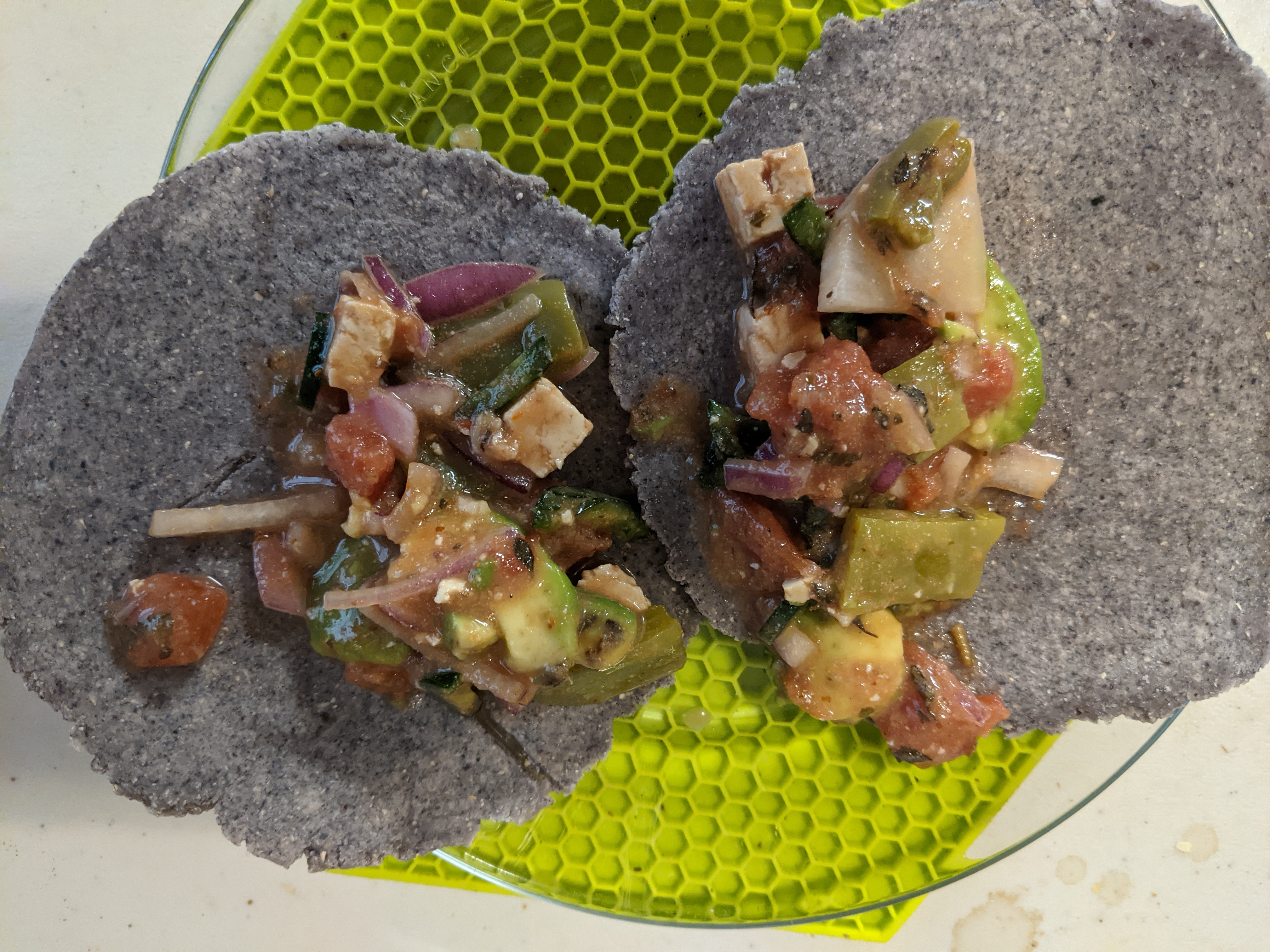
I wrote about cactus salad the first time in January. When I was just hoping to start doing some cooking classes on Mexican cuisine #WFPB style. Covid came along. You know the rest.
But I've gotten back to trying to develop some recipes. And the next evolutionary step follows below:
Ingredients:
3 good size Cactus leaves, cleaned. 1 Red Onions 15 Oz can of diced Tomato Optional: avocado 1/2 bunch Cilantro 2 tbsp (Mexican) Oregano some Radish or daikon, possibly pickled... Serrano peppers and/or fresh jalapeño, or Jalapeño in vinegar 3/2/1 dressing with lemon and lime Pepper to taste Variations: with cubes of firm tofu, or with cevici-style marinated mushrooms
Preparation:
Cut the cactus leaves in 1" strips and cut in 1/2" chunks.
Cook in boiling water with some onion and garlic.
Let cool
meanwhile:
Cut up the red onion
Combine with the diced tomatoes
add the cilantro, Mexican Oregano
add in the radishes, cut fine, and/or the avocado, cut in slivers.
cut up the peppers (jalapeño, serrano, as the case may be)
add the salad dressing
mix and add in the nopales when cool.
Let it marinate in the fridge.
Serving suggestion: with tortillas, or just by itself.
Obviously, you can make this as mild or as spicy as you want.
Just before the Corona virus madness, the plan was to do a series of Mexican classes in my cooking classes at St. Helena's. Hopefully, we will resume in the spring, but until then, I am going to discuss some Mexican recipes.
Yesterday, I made a Three Sisters Posole, but a kind of derivative of the recipe on Nutrition studies. I can never stop improvising, improving (and sometimes making it worse, but learning all the time).
The recipe for Three Sisters Posole
Here are the original recipes on Nutritionstudies in English and Spanish.
So here goes with the revised instructions, but I will include the links to the original. One problem I ran into, my local Mexican grocery did not have blue corn posole, so instead I used Hominy, which is Nixtamalized Corn. Chang Li Market has hominy from the Mama Tere brand. You can get Blue Corn Posole on Amazon. I'll try that next time.
Ingredients
2 cups dried blue corn posole, or hominy
1 cup tepary beans, or any kind of small beans
Optional: you can add some summer Savory to the beans while cooking them
1 cup barley (optional)
2 medium zucchini
4 garlic cloves
2 tsp Mexican Oregano
1 Tbsp ground red chile
8 cups vegetable stock
2 tbsp arrowroot
1 bunch of scallions
1 lime
Sea Salt to taste
Preparation
Cook posole for 2 hours until tender - or shorter if using a pressure
cooker. (Hominy in Instant Pot for 15-20 mins on High pressure)
Cook the beans separately 1.5-2 hours until tender (Instant Pot for 7 mmins or so).
In a large pot, add the minced garlic, chopped onion, zucchini, oregano,, ground chile, and vegetable stock. Bring to a boil.
Add the cooked posole and beans as well as the barley, if you are using it.
Reduce heat and
simmer for about 30 minutes to allow the flavors to come together.
Turn off the heat. Dissolve the 2 tbsp of arrowroot into the soup last and mix in well to thicken the soup.
Add Seasalt to taste
Serve with warm tortillas, wild onions, or scallions. and a squeeze of lemon or lime.
For the most part, you can play a lot with the level of spiciness, and also bear in mind that adding the arrowroot makes it thicker, but also milder.
The other day, we had our "last meeting of the year" for Community Board #9 at the ShopRite on Bruckner Commons and I did my usual 2 minute upate on our activities in this district.
It is some five years ago, when I was an active board member of CB#9, that I began to try and change the tone of our "health fairs" to emphasize prevention over treatment, and eventually it all led to my becoming more active in the Plant-Based community and eventually resigning from the Community Board completely.
First, I hooked up with PlantPure Communities, and then later that evolved into an association with PlantPowered Metro NY, which has emerged as sort of the "on the ground" presence underneath PPC.
NY State Sen Luis Sepulveda
One of the high points of the evening was Senator Luis Sepulveda speaking for the season, and praising my activities related to the Whole Foods, Plant-Based diet, and emphasizing that he himself had lost 43 Lbs (about 20% reduction in weight) and his cholesterol was normal again and his pre-diabetic condition was completely reversed. Hearing those kinds of results is really very powerful. He strongly endorses the diet.
He and his family had already switched to a plant-based diet before they learned about the things I am doing, but the point is, word is getting around.
Bronx Assemblyman Francesco Cabrera is another prominent Bronx Politician who is on the diet, and his experience has been very nearly as dramatic as that of Eric Adams.
I am grateful to know that many people are learning more about the diet and that there are a number of politicians actively involved, first and foremost the Brooklyn Borough President, Eric Adams, but several others in the Bronx and around town. These are the first signs of what will become a true healthcare revolution.
The other day, we had our Lifestyle Medicine dinner at Neerob. Varun Ponmudi, the CEO of Aayas Table gave us a presentation about the six person pilot program they offered in October - a month of WFPB instruction in your own home. Some basic biometrics were reported before and after. The mix of dietary habits was interesting, but on the whole the group averaged out on the healthy side of what is unfortunately normal, nevertheless, the results were significant, including a 4.5 lb weight loss during the period.
Results were good, but there were a few lapses.
Varun Ponmudi presenting results of AayasTable pilot program
Total Cholesterol went down for all six participants, with four out of six reporting ending numbers of below 150, Dr. Esselstyn's definition of "heart-attack-proof."
Triglycerides were more mixed. Two were up and four were down.
LDL at 30 days was down across the board.
A few people lapsed with some oil and processed vegan.
Unfortunately, none of the participants could be attend the dinner at this time, but from personal feedback I know that this program made a critical difference for some people. It is an enormous support to have someone help you out in your own home.
The high point of the evening in many ways was when Md. "Khokon" Rahman, the owner of Neerob, shared his own experiences. In August when he had a heart-attack, he was hospitalized with TC above 180, and his last bloodwork on 10/12/2019 showed TC at 92, prompting his physician to ask him how he did it.
The result is that Khokon is now a leader in his community in this area, along with the Bangladeshi nurse at Elmhurst, Md. Shariful Islam, who spoke at one of our dinners previously. Mr. Islam is always a shining example to me, because he came all the way from Elmhurst to become the patient of Dr. Ostfeld in the Bronx, purely because Dr. Ostfeld is a plant-based cardiologist. Here is a spectacular report on one of Dr. Ostfeld's patients, who googled his way out of bypass surgery to go and use lifestyle medicine instead, becoming a patient in Dr. Ostfeld's Cardiac Wellness Program at Montefiore Hospital in the Bronx.
The whole point of the exercise in a way is that at a point when it is critical, an intervention may be unavoidable, e.g. a stent, or whatever, but as long as it is elective, things can be turned around very quickly on a Whole Foods, Plant-Based diet.
The Food at Neerob
As per usual, Neerob did an outstanding job on the food. A great fresh green salad, a vegetable spaghetti salad, bean soup, a nice dal, brown rice, chinese style veggies, steamed broccoli.
Neerob will become a destination for #WFPB food in the Bronx. They achieved a Plant Pure Communities Restaurant certification in February 2019 and it is getting better all the time.
My qualifications on this particular topic are based mostly on my own experience with doctor visits, which are a relatively rare occurrence in my life. My outlook is heavily informed by the the fact that my father was a doctor and our mealtimes were often mini conferences of him and various colleagues, often focused on their resistance to the formation of what we now call Pharmageddon, or the medical-industrial complex and the de-humanization of medicine. Even then, in the early sixties some doctors were seeing how the new developments in pharmaceuticals made doctors into drug pushers fighting symptoms and not helping patients heal and be healthy. My father had scathing criticism for the pharmacological inroads into psychiatry and eventually evolved into a sort of Jungian psychotherapist more than a psychiatrist because he categorically declined to get involved with psychopharmaca. He also would at times serve patients for free or on a sliding scale whenever insurance stopped covering them, he simply would not accept administrative interference in patient relationships.
The Lifestyle Medicine revolution
Lifestyle Medicine is the new form of medicine that is rooted in the Whole Foods, Plant-Based diet and the insight that nutrition is 80% of the work. In other words, acute issues aside, the first order of business is to make sure you are getting the whole benefit of the whole foods, plant-based diet, for it provides an abundance of nutrients, which puts your body in optimal shape to deal with all of the real life challenges, including preventing or reversing the chronic diseases that kill people who follow a modern, industrial Western diet. So, diet should be your first concern, but that does not mean doctors are an unnecessary luxury.
The slow evolution of lifestyle medicine means we have to be innovative in dealing with doctors. The central point is that you are now taking responsibility for your health, for you decide what goes down the gullet. How far you want to go with that is your business, but besides my wide reading in this area, I went and took the certificate in Plant-Based Nutrition from Nutrition Studies. The new relationship with your doctor, assuming he is a plant-based doctor is a partner in wellness, where he/she should be very much your personal subject matter expert, particularly if there are any challenges and together you can figure out any adjustments that may be needed along the way.
Not necessary, but it helps
In most cases, your regular doctor is in a system that pushes him one way and one way only a consultation and a treatment. Even the ones that do sympathize with the premises of lifestyle medicine and the whole foods, plant-based diet are still in that system. So when this year I had some anomalies in my regular annual physical exam, I decided it was time for some extracurricular consultation, and as it was, I went and visited Dr. Robert Graham at www.freshmednyc.com. He went and took some more extensive tests and together we figured out what was right and what was wrong and some prudent adjustments to make. We are talking about tweaking now, but sometimes it helps to not be guessing and get very specific feedback from a trusted expert who cares.
I learned a lot. Without discussing all the details here, I will highlight one element... just to illustrate why I got concerned with my physical this year.
2015: Spring physical, Total Cholesterol (TC) was 185. My diet was still fairly mixed, although for the most part I did not eat a lot of meat, probably a chicken a week and a hamburger 3 times a year. But lots of eggs, yoghurt, cheese, cheese and more cheese. Still, I always ate plenty of fruit, vegetables and whole grains. I never ate white bread or white rice in my life. I considered that rat food, or window caulking in a pinch. So I probably ate a bit above average. And 185 is not really all that concerning. I just recently read a book about heart disease, "Know Your Real Risk of Heart Disease" by the Australian physician Dr. Warwick Bishop. The book is very well organized, and offers good explanations about how the heart works and what various diagnostics do or don't mean. To him, TC level below 193 would be just fine. In America, regular doctors consider 200-239 the range for borderline concern, so 185 would be of no concern.
And then there is Dr. Caldwell Esselstyn, who says below 150 is heart attack proof. Is he nuts or what? The same Dr. Esselstyn also says again and again that Cardiovascular Disease (CVD) is a paper tiger that need not exist and unless it is absolutely acute and critical, the only intervention we ever need is a whole foods, plant-based diet. He will also point out that anyone eating a Western diet and aged 60 ish will have some level of CVD. And recently, we learned that for our Southeast Asian friends, we could say above 40, for the average age of heart attack victims in e.g. Bangladesh is 43 years of age, because genetically, they have smaller veins.
Here is my personal experience (I wrote about this before when I turned 65):
2015: physical (spring) TC=185
2015: May, re-read Esselstyn's Prevent and Reverse Heart Disease. I decided to quit fooling around and jumped in with both feet.
2016: physical in spring: TC=151
2017: physical in spring: TC=146
2018: no physical
2019: physical in spring: TC=168???
2019: retested three months after my physical, with a more elaborated test (June) TC=145
That was one of a few things that seemed off, and I could not explain except I was probably more religious about going to the gym in 2016 than recently, so time to step up my game, but still.
With further testing and consultation as indicated above, this time TC came back at 145, just two months later. That simply makes more sense given the history, and what I know I am doing with my diet. By the way there was absolutely NO sign of inflammation. Nice to know the diet works, but with the information at hand we figured out I could add another scoop of chia seeds, hemp seeds, (milled) flax seed, or walnuts, to slightly increase my Omega-3 intake. This becomes one of those areas where we're all different, and some may need a bit more than others, but it is important to know that more is not always bettter. It is about the ratio between Omega-6 and Omega-3.
In short, I learned a lot from a very specific consultation that allows me to tweak my lifestyle. It pays not to become complacent. As to diagnostics, initially, here is the only diagnostic you need:
It is a simple self-test for how well you eat based on whole foods, plant-based nutrition criteria. It give you a rating from 1-leaf (slightly above average already) to 4-leaves (you are doing a Whole Food, Plant-Based diet completely) and it is excellent for handholding so you can gradually improve your diet.
Conclusion
If you are doing a Whole Foods, Plant-Based diet, talk about it with your physician. If they ignore it, it may be worth looking for another doctor. That is what happened with me in 2018. I switched away from my old doctor, because he did not know or understand enough about lifestyle medicine and the whole foods, plant-based diet. Of course as soon as I switched my new doctor moved to another state, and I changed doctors again this year.
In terms of doing this diet, for yourself, or for others: don't try to practice medicine without a license, but you can confidently rely on the fact that if you are following the #WFPB diet properly, minus Sugar, Oil and Salt, and plus some natural Omega-3 sources, and your B12 supplement, you are giving your body the optimal chances to heal itself, and many common issues will pass you by unnoticed. Against that background your medical requirements should be extremely modest, and if anything comes up, at least you know you are helping yourself to the maximum.
That latter point is really the theme of the movie The Game Changers, which premieres on Sept 16th (don't miss it!!!). The lead character is a martial arts trainer for the military and he found the whole foods plant-based diet because he wanted to help himself recover from a very serious injury and in his research he stumbled on the fact that the gladiators in Rome ate mostly barley and veggies. That is where his journey started.
Ok, this inspiration started with the discovery of an excellent Bangladeshi food blog on NoorieBoorie.com
Now I want to take some of the recipes and create #WFPB variants that are as authentic as possible.
Spicy Bangladeshi Mashed Potatoes
Here is the link:
https://www.noorieboorie.com/recipes/bangladeshi-spicy-mashed-potatoes/
First of all enjoy the read, the author's love for food is infectious.
Second of all, please realize how easy it is to change this recipe into a completely perfect Whole Foods Plant-Based (#WFPB) variant.
Ingredients
2-3 medium potatoes, peeled
1-2 tsp mustard oil
1 small shallot or 1/3rd small red onion, finely chopped
1 fresh green chili or 1/2 tsp crushed dried red chili
cilantro, finely chopped (optional, for color)
salt to taste
Instructions
Boil the potatoes in a pot of salted water until tender.
Remove potatoes from water, drain completely and let it cool.
Add mustard oil, chilies, onions, cilantro (if using) and
salt into a mixing bowl and mash everything together with your hands.
Add the cooled potatoes to the mixing bowl and mash them (by
hand or with a potato masher), making sure to mix well with the other
ingredients.
Adjust salt and any other seasoning as desired and serve with rice, lentils and curries.
I will call my variant Spicy Bangla #WFPB Mashed Potatoes and here is how it goes:
Spicy Bangla #WFPB Mashed Potatoes
Ingredients
2-3 medium potatoes, peeled
1 tsp mustard seeds ( or 1/4 tsp of mustard powder) soaked in 1 tbsp veggie broth, "mustard broth"
1 small shallot or 1/3rd small red onion, finely chopped
1 fresh green chili or 1/2 tsp crushed dried red chili
cilantro, finely chopped (mandatory, for nutrition)
some liquid aminos if you absolutely have to ;-)
Instructions
Boil the potatoes until tender.
Remove potatoes from water, drain completely and let it cool.
Add mustard broth, chilies, onions, cilantro (if using) and liquid aminos into a mixing bowl and mash everything together with your hands.
Add the cooled potatoes to the mixing bowl and mash them (by
hand or with a potato masher), making sure to mix well with the other
ingredients.
Adjust seasoning as desired and serve with rice, lentils and curries.
Notes
To assemble daal bhaat & bhortas (as shown in photograph above): 1. Start by discarding any large whole spices like bay leaves and green chillies from daal. 2. Spoon the daal into a slightly inverted plate. A shallow plate-bowl works well. 3. Take a small greased bowl and press the rice inside it. Jasmine rice or other rice that is slightly stickier than basmati will work well here. 4. Release the rice onto a separate plate and carefully transfer on top of the plated lentils. 5. Spread a layer of chutney, achar or a bhorta like tomato or eggplant bhorta on top of the rice. 6. Place your aloo bhorta sphere on top. 7. Garnish the plate. (I've used onion sprouts in this photo, but anything green like cilantro, scallion, etc would add a good contrasting pop of color.)
Now, that could not be easier, and it is absolutely delicious.
Just to commemorate our latest supper at Neerob, here are some pictures from this remarkable evening.
Three Salads in one Bowl!
At the table.
The entire group
We frankly devoured our dinner and Neerob did an extraordinary job. They are clearly experimenting with different dishes and aiming to get their PPC Restaurant campaign qualification by January.
The main thing on the agenda was the possbility of launching a Oasis Jumpstart program in the Bronx and to that end, the following resources are possibly involved in creating such a solution:
IFH clinic in Soundview
St. Helena's School Cafeteria & monthly cooking class
ShopRite Bruckner
Neerob Restaurant
Possibly the Sonia Sotomayor Center
Dr. Joel Posner at Monterfiore East
It remains important to see how there is a core support system growing in our district with the following main geographic area:
It was a memorable event and I won't even attempt to produce a full account here by touching on some of the highlights.
I think this was a historical conference, all the greats from the world of the Whole Foods, Plant-Based nutrition were there, creating a very comprehensive view of the field in a single day, with very up to date information.
Robert Ostfeld, MD, MSc, FACC
Neal D. Barnard, MD
Valentin Fuster, MD, PhD
Kim A. Williams, MD, MACC, FAHA, MASNC, FESC
W. H. Wilson Tang, MD, FACC, FAHA, FHFSA
Caldwell B. Esselstyn, Jr., MD, FACS, FACC, FALM
T. Colin Campbell, PhD.
Michelle McMacken, MD
Joel Kahn, MD, FACC
Lauren Graf, MS, RD, CDE
Plus some new players, young doctors just starting and interns, from whom we are sure to hear more in the future. One of them is in the process of launching a new plant-based clinic at Yale. They presented some explosive reports.
T. Colin Campbell for Nobel Prize
What made this conference unique was the presence of T. Colin Campbell, for one way or another, and ex-post facto in some cases, the nutritional science behind the Whole Foods, Plant-Based (#WFPB) paradigm is the anchor for the only realistic healthcare reform in this country and in the world.
T. Colin Campbell
I can only say this: I feel so very grateful to have completed the Plant-based certificate at the institute for nutrition studies, and this was my first opportunity to meet Dr. Campbell in person. All I could do was thank him from the bottom of my heart, since I know that without the nutritional science to back it up, all of these plant-based doctors would just be fighting their lonely battles. Campbell's work is the connective tissue from that point of view. This is the reason that one doctor created a petition to nominate Dr. Campbell for a Nobel Prize. Please sign the petition.
Brooklyn Borough President Eric Adams: "Food is crack."
Here in the Bronx, we are blessed with a few politicians who have their own personal stories to tell about the significance of #WFPB nutrition, such as senator Luis Sepulveda and Council man Fernando Cabrera. However, even in the Bronx' #not62 campaign, #WFPB has not played much of a role yet. In Brooklyn it is different, for Brooklyn Borough President Eric Adams is truly a man on a mission and being very effective at it.
Eric's own story is remarkable, having been predictably (as he now recognizes), but 'unexpectedly' (denial is NOT a rive in Egypt!) diagnosed with diabetes, and told he would have to be on insulin and several medications, instead, he googled "reversing diabetes," and made an appointment do see Dr. Esselstyn in Cleveland and on the plane he read Dr. Greger's book How not to die. Having been told he might lose his eyesight altogether, he instead completely recovered it in three weeks without medications, and in three months he was no longer a diabetic. Earlier this year, his 80-year old mother decided that she wanted some of what Eric had, and in a few months she was off of insulin and medications.
Eric is in the unique position to really do something about this new found wisdom and he has not skipped a beat. His events at Borough Hall are not to be missed.
In an impassioned speech, Eric Adams called our industrialized food out because of what it does, adulterated as it is to create the cravings that brings customers back again and again, he stated what is exactly the point: "Food is crack." This is even more painfully true in the African American community where "soul food," made a virtue out of necessity, and is the cause why "Southern food," with it's reliance on meat, grease and sugar and other refined carbs is an extremely unhealthy diet.
Finally, he acknowledged Dr. Michelle McMacken, who will be heading up the new plant-based program at Bellevue Hospital.
Dr. Kim Williams: Reducing risk of heart disease by 50% for blacks
Dr. Kim Williams in audience, Dr. Neal Barnard on stage
When Dr. Kim Williams spoke later in the day, he raised the same issue by pointing out that changing from a "Southern diet" (and as Dr. Williams pointed out this is code for a black diet), to a Whole Foods, Plant-Based diet reduces risk of heart disease by 50%. The romance with soul food, which is understandable, because it did make a virtue out of necessity and symbolized the resilience of black culture under atrocious conditions has become the new slavery. Thus the Whole Foods, Plant-Based diet symbolizes a new freedom. The beauty is that this time around, we have a combination of clinical experience from all the doctors in this field, backed by the nutritional science of Dr. T. Colin Campbell. The growing recognition of this new lifestyle is decisively the most hopeful thing that is happening in the healthcare field, in America and world-wide. Here is an interview with Dr. Williams:
At the end, Dr. Williams was also on the panel, and an important question came up from a Bangladeshi man, who is a nurse at Elmhurst Hospital in Queens, but came to the Bronx to become a patient of Dr. Robert Ostfeld, because he could not find a plant-based cardiologist at the time when he had his first heart-attack at age 36. In Dr. Williams' answer we learned that the American College of Cardiology recently visited Bangladesh, where the average age of heart attack patients is 43, apparently in part because genetically blood vessels are narrower in that population than is typically the case with Westerners, so that blockages develop earlier. In short, the Bangladeshi population should be extremely interested in the opportunity to drastically improve their quality of life and life-expectancy by switching to a Whole Foods, Plant-Based diet. It is also well known that diabetes is explosive in the South East Asian population, with white rice, animal protein and cooking oil being a leading causes. In the Western world in particular, food is the leading cause of death, but some populations are just genetically more prone to this form of suffering. Fortunately, it is reversible and the Southeast Asian cuisine offers a very good starting point for brown rice, lentils and chick peas as well as many of the traditional vegetables and spices can create endless variations of healthy food with very little effort.
Dr. Valentin Fuster speaks of starting early
Some of the Bangladeshi doctors I've gotten to know, were familiar with Dr. Valentin Fuster from the cardiology textbook he wrote, which they apparently used in medical school in Bangladesh. Dr. Fuster presented a very information-laden speech on the need to start early, in particular by teaching children. He has been a medical adviser to Sesame Street to do exactly that.
Treating the disease at the end state is expensive, not to mention unaffordable, and more than "prevention," starting with adults with bad habits already formed, he argues for starting with children. It was very compelling.
Dr. Ostfeld, common sense in underserved communities
With his usual, delightful and very gentle sense of humor, Dr. Ostfeld presented some of his experiences and solutions in serving a very under-served community in the Bronx and making affordable solutions work, including his practice of funneling all of his patients with their significant others into a half-day workshop on Whole Foods, Plant-Based cooking.
He mentioned some of the many sources which are available for inspiration to live a plant-based lifestyle on a budget, including some links on Forks over Knives which discuss plant-based living on a budget:
(In general you can find more by searching for "budget" on Forks over Knives.)
Particularly important is his clinical experience of how he gets patients motivated to comply, but the all important first step is to simply demonstrate that the improvements to be had from the plant-based diet out perform any drugs, such as statins.
Dr. Ostfeld's support system
He builds it up from a 30-minute first visit, which is largely fact finding and an initial plan, to a second follow-up visit and an invitation to his plant-based workshop. He is truly a leader in this emerging field. The PBNSG.org website he mentioned is another important resource.
Through the looking glass with Dr. Wilson Tang
In a fascinating presentation, Dr. Wilson Tang took us into the latest finds in the rapidly advancing field of understanding the gut biota with the primary bad boy being TMAO. Specifically, the fact that TMAO is a flagrant demonstration of oxidative stress in the body and comes from animal nutrition is interesting, and should point people quickly to diet as a cause for heart disease. Planteaters simply do not have the problem of this major villain lurking in their gut. See here some info from the Cleveland Clinic.
This type of information has us looking at causation, and at the same time puts us on a track to fixing it, for maybe, just maybe, if we ate something different, the outcome could be different... what would that be? Oh wait... Whole Foods, Plant-Based nutrition of course.
To hell and back with Essy, or... Dr. Esselstyn for you
Actually the discussion with Dr. Wilson Tang showed us the road to hell, and Dr. Esselstyn first showed us what heart disease looks like up close and what healing looks like. He took us through his experiences, including all the supporting evidence for #WFPB in general, and with particular attention to how eating a hand full of green leafy vegetables with balsamic vinegar, paves the way back, because it creates the nitric oxide which heals the endothelium and keeps our arteries limber. The deeper point is, as always, that 'vegans´ only know what you don't eat, and #WFPB is about knowing what you should eat and why. Once you have a firm understanding of that, it should be a lot easier to comply. Dr. Esselstyn's discussion of how a fatty meal prevents the normal expansion of the arteries, which is supposed to occur with strenuous effort, for four to six hours after that meal... by which time we eat again, is priceless and should also be powerful motivation for beginners. Understanding why you should do ABC or D, is the most important thing to get people to do it.
Notes on Keto-diets
The ketogenic diet is sort of an urban myth that refuses to die. There's always a new huckster promoting it. Throughout the day it came up both directly and indirectly. The information on TMAO in the gut of meat eaters alone should make it clear why this type of a diet comes with increased risk and mortality in the long run. Heart disease, diabetes, and cancer have all been associated with meat consumption. In short, there is nothing scientific about it. Dr. Joel Kahn had a recent article on How to Evaluate Nutrition Science (And Why Cranky Old Men on Twitter are Not the Source) which is yet another refutation of this particular craze.
Conclusion
This conference took place at a time when more and more people realize that we cannot continue with a healthcare system that consumes 20% of our Gross National Product and two times what the next most expensive country pays, but produces health outcomes that are somewhere in the range of 25th to 50th in the world, depending on which analysis you follow. Since 37 of the top 40 leading causes of death, mostly the typical, chronic diseases of affluence that are thought to be incurable, respond well to a Whole Foods, Plant-Based diet and many are preventable or even reversible with such a diet, it is becoming increasingly imperative we make the change, even if it takes a generation. We cannot afford not to.
The question period at the end was exhaustive - every last question was answered. Again, I left out a lot of detail here, in order to present sort of a bird's eye view of this whole affair, which we are blessed to have in the Bronx, if we ever hope to get serious about #not62.
We had another lovely #WFPB supper at Neerob Restaurant, with the usual GABA Brown Basmati Rice, and dishes of Vegetables, preceded by a brilliant and very aromatic cucumber and tomato salad.
The vegetable dishes included a dish of yellow split lentils with malabar spinach (poi leaf), a delicious dish with Okra, a dish with Broccoli and a dish with Cauliflower.
All in all it was a glorious meal and a perfect example of how good plant-based meals can be.
Khokon, the owner of Neerob Restaurant was one of the people who very quickly "got it," once I explained to him the first time how to cook without oil. Muhammed Mujumder stopped by to sample some of the meal as well...
Our neighborhood was just greatly enriched with a new ShopRite at Bruckner Commons. It is a magnificent improvement to the quality of life in our area.
This time, I am not going to use a lot of words, but I will provide some of the pictures, and then at another time I will provide some more detailed explorations of what the store has to offer for the #WFPB shopper. First however, I will analyze the little shopping bag I brought home and explain why I will be going back to this store probably once a week, or certainly every week or two, despite the fact that I have a great selection nearby. Simply put, ShopRite has enough specialty items that I cannot get everywhere, except downtown or on-line. So here goes with my shopping bag:
Celery Root $2.61 - I can get it sometimes at the farmer's market at Virginia Park. A recipe: shred it, and make a salad of it by marinating overnight with raisins, lemon and honey.
Radiccio $2.25 - have to go downtown for that one, until now. Recipe: shred it and add to any salad.
Artichokes, 3 for $5 - same thing, down town only, until now. Recipe: boil in water until you can pull out the leaves (20-30 mins), and eat with a 3/2/1 dressing with lemon or lime.
Belgian Endives $3.74 - and gain, down town only, until now... Recipe: core them. Use in salads sliced thin, or make a salad with a 3/2/1 dressing with lemon or lime, with some walnuts and some raisins.
Steel Cut Oats, Wholesome Pantry, 30 Oz. $3.19 (10.63 cents/Oz). For recipes, see the links below.
For those who have followed my oatmeal shopping expedition, this store label organic steel cut oats is a great value at $0.11/Oz., on a par with buying organic steel cut oats in bulk downtown. Here, by the way is my major post on oatmeal, which is truly the breakfast of champions.
On a tour: Without a lot of comments, here is a visual tour, pictures taken in haste, but I will revisit some of the sections in the future. This store is on my itinerary now.
Oat milk
They believe in salad
The possibilities are endless...
Fruit galore
Veggies, veggies
Polenta rolls
Spices
And finally, here comes Angela Vita. Ask her anything, be specific about your diet. She definitely does know what a Whole Foods, Plant-Based diet is all about:
Angela Vita - Retail Nutritionist
Vinegars
Whole Grain Pastas
Some real finds in the frozen section, helping you to always be ready!